Friday, October 11, 2019

Oct. 3, 2019: Triangle-wide transit campaign spotlights real people, real stories, real solutions

Research Triangle Park, NC (Oct. 3, 2019) – All kinds of Triangle residents have discovered that leaving the driving on our increasingly stop-and-go roads to an unflappable bus operator can be life-changing, and it’s a discovery the area’s transit agencies want more people to make as a three-county investment in transit continuously improves our regional network.
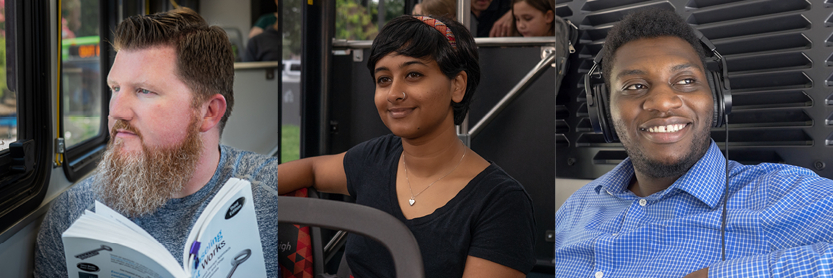
Together, GoCary, GoDurham, GoRaleigh and GoTriangle have produced the “Your Better Way to Go Campaign” to tell real stories of real riders sharing the good news about how transit can be, among other things, your stress-free, reliable, affordable and earth-friendly way to go.
“With Wake, Orange and Durham counties together growing by more than 80 people a day, our roads are going to get only more crowded, and transit will become the better way to go for more and more people,” says Mike Charbonneau, chief communications officer for GoTriangle. “We want those who aren’t taking a bus right now to see how easy and life-altering it can be.”
better way to go
As part of the campaign, you’ll see Phinehas, a jazz musician from Durham who has taken the bus to gigs and to lessons with his guitar students.
“Music teaches life sometimes. It teaches good life skills and keeps kids focused, and I’m happy to be a part of that,” he says. “I’ve been able to make my appointments riding the bus. If they say 3:30, my bus gets me there around 3 o’clock, and we’re all set. I walk to your house and it’s over and I walk back out and go to the bus again.”
Billy is a longtime Wake County public school teacher who took the bus to graduate school to get his master’s in school counseling.
“There really is a quality of life issue,” he says. “As you’re driving in the morning and traffic gets worse, there’s a multiplier effect on your mood and your state of mind. Seventy minutes of a relaxing commute on the bus with time to work is much better than a stressful hands-on commute.”
Shaina is a community organizer who takes the bus to get around to entertainment and meetings.
“By the end of [my last job], I almost felt like I was working the job to make enough money to pay for my car to get to my job,” she says. “It was depressing. I used a tank of gas every week. My tires were getting worn out. I had to pay $500 to get those replaced.”  
Find out more about how to find your better way to go at yourbetterwaytogo.org.

Sept. 10, 2019: 460,000! That's how many transit trips Youth GoPass holders took in program’s first year

Research Triangle Park, NC (Sept. 10, 2019) – In the first year of the Youth GoPass program, the Triangle’s teenagers used their free passes to board public buses to get to school, work or play across Orange, Durham and Wake counties more than 460,000 times.
Altogether, more than 6,600 teens ages 13 to 18 signed up for Youth GoPasses between July 2018 and June 30, 2019. For a list of where you can get a Youth GoPass and for more information about how the program works, please see youthgopass.com. The pass is good for free rides on all GoCary, GoDurham , GoRaleigh and GoTriangle routes. Transit in Orange County is free for everyone.
Now that the traditional school year has started up again, the transit agencies are hoping even more teenagers learn how easy it is to get a pass at Wake, Durham and Orange public libraries, Raleigh Parks and Recreation community centers and transit agency ticket counters and how valuable that free ticket to ride can be.
“We couldn’t be more pleased about our young neighbors using their new Youth GoPasses nearly a half a million times to take advantage of the access a growing transit network provides,” says Shelley Blake Curran, interim CEO and president of GoTriangle. “Transportation should never be a barrier to education or other opportunities for anyone, and our continued community investment in transit and programs like the Youth GoPass help connect more people to a lifetime of possibilities.”
Christopher Reynolds, 17, is one of more than 400 Broughton High School students with a Youth GoPass, and he uses his every day to take GoRaleigh Route 8 between his home and school. His family had been spending about $50 a month for him to use public transportation before the free Youth GoPass program started last year.
“My grandma read about the pass, and she printed out the articles about it,” Christopher says. “My mom picked me up from school one day and we went to the library, and we got it. All I needed was a student ID, which I had on me. It’s easy.”

Aug. 14, 2019: For those 65 or older, it’s now free to explore, travel, ride all over the Triangle

Research Triangle Park, NC (Aug. 14, 2019) – Added to the myriad practical reasons that Andrew Leager likes taking the bus to meet friends or run errands around the Triangle are four precious ones: Tripp, Henry, Weston and Ames.
It’s the thought of his four grandchildren inheriting a planet we’ve polluted with our car-centric ways that primarily propels Leager, a 71-year-old Raleigh native, onto public transportation.
Now GoTriangle is reducing the cost of Leager’s reducing his carbon footprint.
On Aug. 4, all customers 65 and older became eligible to ride all GoTriangle routes free simply by showing a photo ID with birthdate. The change means that members of that age group now can ride free on all transit agencies in the Triangle, although each agency has its own rules for boarding. 
“Continued access to all of the wonderful things in our community is critical to our older neighbors who maybe want to stop driving or limit their driving on our crowded roads,” says Shelley Blake, GoTriangle’s interim CEO and president. “GoTriangle is happy to be making it even easier for those 65 and up to get to health care appointments or restaurants or other places they want to see or visit.”
Leager, an avid bicyclist, lives in a walkable part of downtown Raleigh and drives his truck only about half the time he travels. He has used public transit to get to North Hills to meet a friend for lunch, to Cary to enjoy a beer at a local pub and to Durham to keep a date with a woman he met online.
“My love of transit is multifaceted,” says Leager, who has been an architect, an actor, a bar owner and a barrel-maker. “The bottom line is that I’m really concerned about my grandchildren’s future world. If all of us drove our vehicles 50 percent less, just think of the saving of fossil fuels. I want to do my part to live in a world where we don’t drive our cars as much.”

July 30, 2019: A trip through transit leads Wake teachers to real-world lesson plans

If 10 teachers leave Durham at 11:45 a.m. and travel on a GoTriangle Route 100 bus to see the transit stops at Raleigh-Durham International Airport before riding at 65 mph on I-40 to downtown Raleigh, how long does it take them to come up with 23 new lesson plans involving transit?
OK, so the Wake County public school teachers who spent a day with GoTriangle staff members as part of WakeEd Partnership’s SummerSTEM program may never use the experience to write word problems for math tests, but they left excited about creating other real-life lessons in comparative and data analysis, politics, government, economics, mapping, conservation, budgets and more.
“We always think huge on global problems and their impact,” said Emily Hardee, STEM coordinator at Brentwood Elementary School in Raleigh. “But for many of our students, it’s all about what’s right outside their houses a lot of the time.”
Hardee was the coach for the contingent of teachers visiting GoTriangle last week as part of the SummerSTEM collaboration among WakeEd Partnership, the Wake County Public School System and STEM businesses and organizations. About 100 WCPSS educators visit businesses each summer to get hands-on experiences in STEM fields so that they can take real-world lessons back to the classroom.
At GoTriangle, the day’s goal was two-fold: to immerse the teachers in all things transit to spark some creative lesson planning and to impart enough practical knowledge that they could help their school families navigate the transit network. Extra credit: getting a feel for what it’s like to be dependent on transit as some of their students and families are.

May 20. 2019: Canes mural ready for community close-ups! Now, meet the painter who got his art start on the bus

Raleigh artist Sean Kernick is quick to draw the conclusion that he might not have had an art career at all if it weren’t for the time he spent filling up sketchbooks on his daily trips on public transportation to and from school in Philadelphia.
From sixth through 12th grades, Kernick spent a total of 90 minutes each day riding, chatting, laughing and sketching along the streets of Philly, where he also picked up some spray-painting skills providing some admittedly, um, unsanctioned art with his teenaged friends.
“Time on public transportation, it’s like when you get lost in thought driving but without the responsibility of driving,” he says. “Imagine the kind of ideas you can think through and work out in your head by just taking the time to have somebody else take you from place to place. That’s where 80 percent of my sketchbook got filled up at was on the bus.”
Canes Country is the most recent beneficiary of Kernick’s self-taught talents, which were put to use this month turning the wall of a building that GoTriangle owns into a tribute to the Carolina Hurricanes’ post-season run to the Eastern Conference Finals.
“We’re honored to work with the Raleigh Murals Project and truly appreciate GoTriangle’s support in our efforts to expand the Carolina Hurricanes’ footprint in the region,” says Dan LaTorraca, director of digital marketing for the Carolina Hurricanes. “The organization is proud to showcase the creativity of local artists and leave our mark on the city that has shown us tremendous support.”
Find the mural at the corner of Harrington and Lane streets in downtown Raleigh, celebrate the Canes and snap some pictures. A gallery of downloadable photos is available here.
“We could not be more excited about this joint partnership with the Hurricanes and the Raleigh Murals Project,” says Mike Charbonneau, GoTriangle’s chief communications officer. “Now that the mural is finished, we hope the community will come by the property to enjoy it, take selfies, celebrate, whatever makes them feel like they’re a part of the energy that this Canes team and its post-season success have poured into our community.”
The Raleigh Murals Project connected Kernick, the Canes and GoTriangle, with the team providing the money for the artist and GoTriangle donating the building as the canvas.
“Not until this moment, I hadn’t remembered so deeply my love with the bus, and having the connection between the buses and this wall here, it really adds another layer to make this project super special,” Kernick says. “I still know what bus number I took. I took the 27 bus to and from school, and the connection that it created with me and other people in my community still stands to this day.”

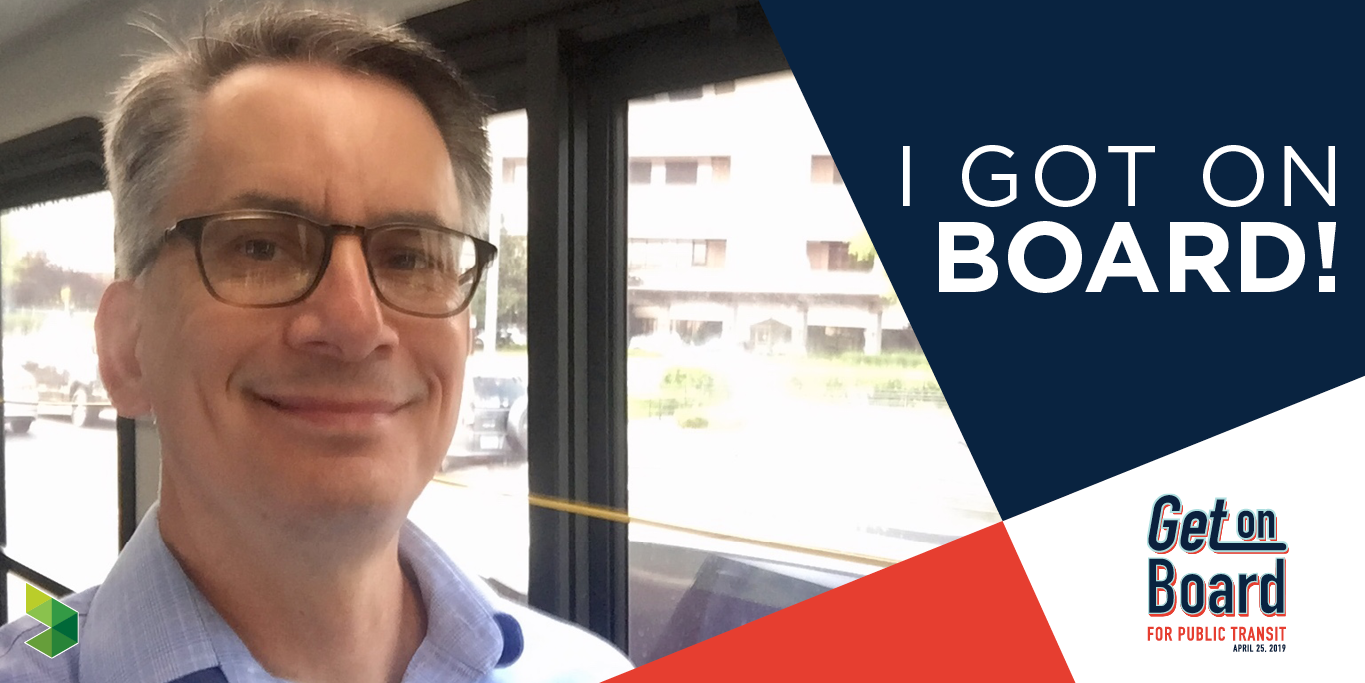
May 17. 2019: He got on board! New home, new route, peace of mind

Research Triangle Park, NC (May 17, 2019) –  A free pass was just the nudge Andy Bechtel needed to try transit from his new home in downtown Durham to his job as an associate professor of journalism at the University of North Carolina at Chapel Hill.
When he lived in Raleigh, Bechtel had made a habit of riding GoTriangle’s Chapel Hill to Raleigh express bus for well more than a decade, but since his move to Durham last summer, he hadn’t much explored his transit options.
When GoTriangle offered a free ride in honor of national Get on Board Day last month, he decided it was time to look at bus schedules and routes from his new home. A stop for GoTriangle Route 400 between Durham and Chapel Hill is a 10-minute walk from his apartment, he found.
“That campaign was a nice reminder, making me think, ‘Sure, let me give this a try from my new location,’” Bechtel says. “It was easy to find where the bus was. It was easy to ride it. It was on time. It’s not an express route, so it does stop along the way, but it only added 5 to 10 minutes to my drive time, and that’s something I’m willing to do to save myself the aggravation of driving on 15-501 at 5 p.m.”
Bechtel says the Get on Board timing couldn’t have been better because he also had noticed that the price of gas was creeping up again.
“It’s not only the stress relief of being on the bus, I’m saving money on gasoline and wear and tear on my car, too,” he says.

May 16, 2019: Raleigh artist finds biking to work brings sense of belonging, real insight into city

On Friday, before artist Annie Blazejack straps on her bike helmet and pedals from her home in the Five Points area of Raleigh to her studio 4 miles away, she’ll check the weather so she can choose the appropriate clothes on national Bike to Work Day.
She’ll plan her route along the city’s backstreets, a route she’s still perfecting since moving from Miami, Florida, to Raleigh in September. Finding a path that avoids busy roads or sidewalks all together has eluded her.
And, chances are, once on her way, she’ll stop a few times to enjoy a remarkable sight or to get a coffee, which she’ll put in the water bottle holder on her bike.
This is Blazejack’s every workday routine, unless the weather is particularly bad. In that case, she’ll take an Uber, guilt-free, because of the money she and her husband have saved by owning only one car.
“He uses it for his commute because he found a job in Durham,” Blazejack says. “He has an awful commute via car, and I have a lovely commute I really like, and it’s a bike ride.”
Not having a car payment and all of the other attendant costs of owning a vehicle for 10 years meant the couple could afford to buy their first home in Raleigh.
“There’s the personal health benefit to riding your bike, no question,” Blazejack says. “Everyone kind of knows that. There’s the environmental benefit of not being responsible for all of those emissions, not being responsible for the material for making one more car. And then I think it also can be a big financial benefit, depending on how you set yourself up.”

May 8, 2019: She got on board! First transit trip turns Cary commuter into forever fan

Seeing a GoTriangle tweet offering a free bus pass to honor national Get on Board Day last month, Diane Dulaney realized she was out of excuses not to try transit.
When Dulaney’s two boys were younger, carpool duties kept her chained to her car, but with one son in college and one in high school now, she was ready to break free.
The free pass was the key.
“It took one time,” says Dulaney, a Cary resident who works as a project manager for the state Department of Public Instruction in downtown Raleigh. “I rode the bus on Tuesday, and on Wednesday I marched myself down to the state parking office and got my GoPass. I liked it so much I convinced my husband to ride the bus with me on Thursday.”
Dulaney, who has used public transit in larger cities such as New York and Boston, says she had some slight trepidation about her first bus trip in Wake County.
“The bus drivers are great,” she says. “They were very patient with me. The first day I bumbled through it. I couldn’t figure out how to swipe my card. I pulled my cord too early. The bus driver said, ‘Do you really want to get off here?’ He was super nice.”
Dulaney’s husband works on the NC State University campus, so he also has access to an employer-sponsored GoPass, which allows people to ride free on any transit agency in the Triangle. Dulaney says having both of them tuned in to transit will help the family this summer when her college son is home and needs a car.
“I’m not buying him a car for the summer so I was going to have to carpool with my husband,” she says. “Taking the bus is going to be much better than carpooling because we just have such different schedules.
From her home in east Cary, Dulaney is able to walk about 5 minutes to a bus stop that serves GoTriangle Route 301, which travels Western Boulevard and drops her off right at her office door on Wilmington Street in Raleigh. Her morning bus commute takes roughly the same amount of time as driving, although the evening bus commute can be a bit longer.
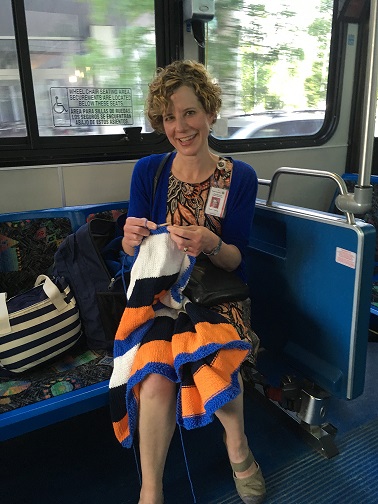
“But I really love the time I get back,” Dulaney says. “I can read on the bus. I can knit. I love to knit. I’m making this ridiculously large afghan for my son. The last one took me a year. I’m thinking if I take the bus more, I can finish this one in six months.”
Dulaney’s ultimate goal, now that one week of GoTriangle service has made her a transit lover and advocate, is to get rid of a car completely.
“If a family truly saves $10,000 a year by going down to one car, that’s a great trip you can take every year,” she says. “A great trip! And if you don’t drive, you’re so much more likely to ride a bike or walk. I don’t like to sit in a car. I’d rather be moving. And I really do feel guilty from an environmental standpoint driving my car alone to work every day.”
Dulaney is anticipating that as the Triangle keeps growing by 80 people a day, transit is going to be more than a money saver for her. It will also be a moneymaker.
“Selfishly, the fact that my house is so close to the bus line will make my house even more valuable,” says Dulaney, who lives in what she describes as an old part of Cary that made it an affordable place to buy a home 14 years ago. “Probably in 10 years, people will really start looking for that. So I want the transit system to be stronger and better, and the way for that to happen is for people to start riding the bus.”
That’s the paradox of transit planning that can be hard to understand. The more accessible transit is, the more people will ride it, so if you wait for more people to ride it before you make it more accessible, nobody wins.
“Transit is a vicious cycle or a virtuous cycle,” Dulaney says. “The more people ride the bus, the more routes we have and the better it is, and the fewer who ride, the fewer routes we have. I want it to be a virtuous cycle.”

Durham, Orange and Wake counties all have half-cent sales taxes devoted to transit improvements, so the network becomes more accessible and vast every year. Find more information here.

April 19, 2019: Head toward a car-free life by riding GoTriangle free one day next week

Research Triangle Park, NC (April 19, 2019) – The fact is, to those who know too little about the ever-expanding transit options in the Triangle, Kimberley Sirk’s nearly car-free life might seem fictional.
Three days a week, the City of Raleigh employee doesn’t touch her car at all, instead walking along a lovely greenway to a bus stop near her home in Cary and taking a GoTriangle bus to her job in downtown Raleigh and back. The other two weekdays, she catches a different GoTriangle bus from a park-and-ride lot at a Cary shopping center, attending yoga or getting groceries there before she drives home in the evenings. 
Headed out of town, she takes her suitcase on the bus to work and then rides GoTriangle Route 100 from downtown Raleigh to the airport. Off to see a Durham Bulls game, she parks at the Regional Transit Center and takes GoTriangle Route 700 into downtown Durham. To get to a dentist appointment, she rides the free downtown Raleigh R Line from her office to her dentist in Glenwood South.
Creating your own sensational transit story starts with the first ride – and GoTriangle wants to make it even easier by making it free.
In honor of national Get on Board Day on Thursday, April 25, riders can download and print a free pass to use any day next week on any of the agency’s 22 express and regional routes. Find more information about the American Public Transportation Association’s national Get on Board campaign and get the free pass here.
“We really wanted to make it convenient for people to try,” says Wendy Mallon, GoTriangle’s marketing manager. “We usually have a fare-free day to get people to try transit, but this is the first time we’ve given people the option to try it free on a day throughout a whole week that works best for them. Every year, we’re putting more buses on the road going to more places more frequently, so I really hope people will go see what transit opportunities are available to them.”

Feb. 26, 2019: GoTriangle wins national first-place communications award for Hurricane Relief Bus coverage

Research Triangle Park, NC (Feb. 26, 2019) – GoTriangle has won a national award in the annual APTA AdWheel competition, taking first place in the Best Marketing and Communications Educational Effort: Special Event for its work collecting and delivering donations to Eastern North Carolina in the wake of Hurricane Florence last fall.
Mike Charbonneau, GoTriangle’s director of communications and marketing, accepted the American Public Transportation Association award on behalf of the entire organization at a conference in New Orleans this week.
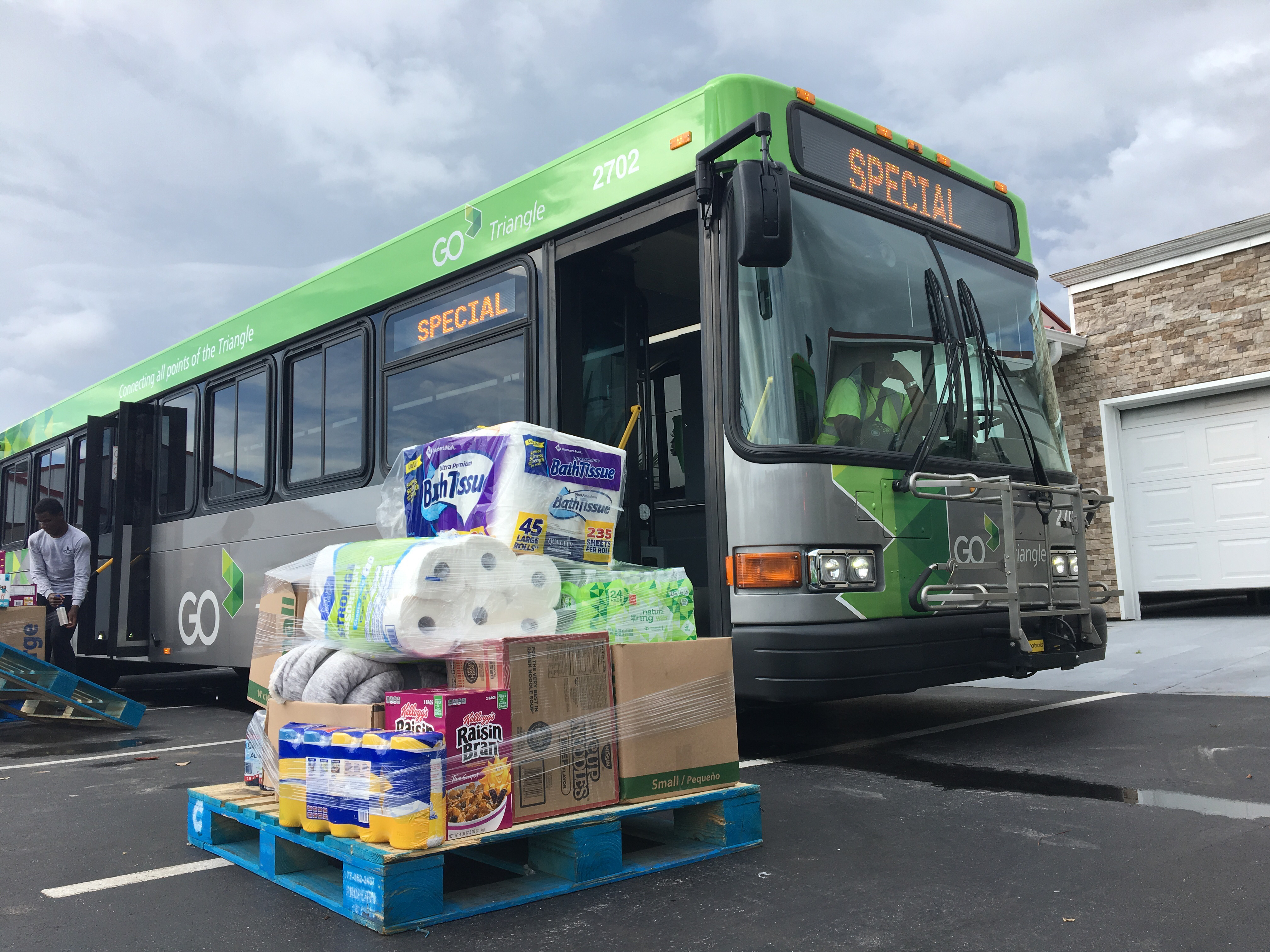
“Even before it was clear to us in the Triangle just how devastating Hurricane Florence had been for our neighbors to the east, we had begun working with partners to coordinate a donation drive so we could rapidly respond to their needs,” says Charbonneau, noting that nearly every GoTriangle department was represented in the volunteer effort. “We are very thankful for how amazingly generous Triangle residents were in showing up on an 87-degree day to our Hurricane Relief Bus event with carload after carload of desperately needed goods.”
On Sept. 14, 2018, Hurricane Florence made landfall in Wrightsville Beach, with its storm surge and days of rain causing historic widespread flooding that damaged tens of thousands of homes. More than 20,000 people in North Carolina spent time in shelters, and parts of Interstate 95 and Interstate 40 were closed.
GoTriangle’s Hurricane Relief Bus drive at Carter-Finley Stadium in Raleigh was part of a larger Here to Help: Hurricane Relief effort orchestrated by WRAL-TV that also included the United Ways of North Carolina and the Greater Triangle, the Food Bank of Central & Eastern North Carolina, GoTriangle, Alliance Health and NC State University.
In 13 hours, the drive netted more than 60,000 pounds of supplies that filled five buses, three vans, a box truck and part of a tractor-trailer.  The next week, GoTriangle, GoDurham and partner volunteers delivered the goods to United Way collection points in Newport and Lumberton.
Lisa Jo Douglas had been waiting in Lumberton to help unpack the buses.
“I saw those three buses coming, and I said to myself, ‘We are not alone in this’,” Douglas said that day. “God sent you to bless our community and, from the heart, we do appreciate it all.”
GoTriangle’s campaign included a brief promotional video, social media graphics and a news release to promote the drive. Throughout the collection day, staff members provided live reports on WRAL’s Facebook platform to show our community the progress being made throughout the day in real-time and to continue highlighting what was still needed.  
GoTriangle also produced a news release and comprehensive video story of the deliveries to the devastated communities in Eastern North Carolina so Triangle community members could see their kindness at work.
According to the North Carolina Department of Public Safety, more than 600 North Carolinians affected by Hurricane Florence remain in hotels through FEMA's Transitional Sheltering Assistance program.
GoTriangle spearheaded a similar donation drive in the wake of Hurricane Matthew in 2016.

Feb. 14, 2019: Roses are red. In cars, we stew. Let this be the year you try something new.

Research Triangle Park, NC (Feb. 14, 2019) – Chances are, if you live in the Triangle, your relationship this Valentine’s Day is going nowhere fast.
You’re stuck in a rut (or at least on I-40), and the rest of the monogamous multitudes around you are, too.
Might be time to ditch the high-maintenance darling or even do some online dating -- at gotriangle.org. Swipe right for buses, bikes and carpools!
Getting car-struck motorists to explore a new match or, more accurately, a new mode of transportation was the goal of the online campaign that GoTriangle launched this month in tantalizing fashion.
During the first week of February, GoTriangle’s Twitter and Facebook posts featured pictures of Valentine’s Day cards with breakup themes but no other information. Who was breaking up with whom? The answers started trickling out in video form Feb. 6.
“It’s just for fun, a kitschy way to get people to stop and look at something that makes them laugh but also to say, ‘You know what? I haven’t thought about that. Is my car hurting my health? Is it taking money out of my pocket? Is traffic ruining my life?’ ” says Wendy Mallon, GoTriangle’s manager of marketing. “I personally spend an hour and half in traffic every day, and breaking up with my car would be a welcome change in my life. I’m really looking forward to the transit investments the community is making in Wake County that will increase my options.”
Each of the six videos highlights a different reason for people to give their cars the cold shoulder, at least some of the time, and try transit. What could be better than letting someone else do the driving through traffic, making better use of your time, saving money and helping the environment?

Dec. 27, 2018: 2018 a year of improved routes, new teen riders and commitment to community

On GoTriangle

Research Triangle Park, NC (Dec. 27, 2018) – Two or three times a year, Pierre Tong happily leaves his car at home and takes GoTriangle Route 100 to Raleigh-Durham International Airport, so he finds it perplexing that the No. 1 misconception he hears about transit in the Triangle is that there is none to the airport.
“Well, there actually is,” Tong says, and adding even more service to RDU was one of the first improvements made in the first full fiscal year of the Wake Transit Plan that voters approved in late 2016.
“Whenever you have more frequency, that’s less time you have to wait for a bus when your plane comes back and gives you more options to get there,” says Tong, a civil engineer who lives in Raleigh. “That way you’re not getting there too early or too late. There are lots of benefits to having increased frequency.”
Increased frequency and more coverage have been two main focuses of the many improvements that GoTriangle and other area transit agencies have made over the past 18 months. GoTriangle, as the Triangle’s regional transit agency, runs routes between municipalities and gets funds from Orange, Durham and Wake counties. Voters in all three counties have approved half-cent sales taxes devoted to transit improvements, and each county has an approved transit plan that works with the others to create a unified, regional transit network.
In addition to adding half-hour service to Route 100 in August 2017, GoTriangle added half-hour and Sunday service on Route 300 from Raleigh to Cary and continued the Fuquay-Varina express service to GoRaleigh station.

At the same time, GoTriangle Routes 700 to Durham and 800 to Chapel Hill moved from hourly to 30-minute service Monday through Saturday until 7 p.m., making it even more convenient for residents to get out of their cars and enjoy the benefits of buses.
“With all three counties investing in transit improvements that work together, GoTriangle is looking forward to rolling out the next phases of bus improvements that give our riders even more choices and accessibility,” says GoTriangle CEO and President Jeff Mann. “With the Triangle growing by more than 80 people a day, increasing transit options is one of the most important things we as a region can do.”

Dec. 7, 2018: How guiding growth around light-rail stations can generate $1.4 billion in new tax revenue, thousands of jobs

With the light-rail line will come the transformative opportunity to convert parking lots, vacant stores and unused land in Orange and Durham counties into walkable communities that provide a mix of homes, jobs and community gathering places for the Triangle’s ever-growing population and generate enough new property tax revenue to pay for other public priorities.
How much new tax revenue? From $1.4 billion to $1.9 billion over the next 40 years.
That is not an imaginary number but the result of a nearly two-year analysis that Gateway Planning conducted encompassing all of the project’s stations. For the analysis, Gateway worked with GoTriangle, Durham, Chapel Hill and the Triangle-J Council of Governments, which as a group received a $1.7 million federal grant to study transit-oriented development opportunities around the 17.7-mile light-rail project connecting Chapel Hill and Durham.
Using community input and market analyses as guides, Gateway drew up possible development outcomes for each station and compiled its work into a guidebook, available here. The guidebook tries to best capture the opportunity the light rail brings to guide growth, expand access to jobs and opportunity, and generate tax revenue that allows the region to invest in other goals. The guidebook is also intended to serve as a helpful blueprint for what actions Durham, Chapel Hill and their county partners can take to realize the benefits that transit-oriented development brings.
Without the light-rail line, many of the station areas will look largely the same 40 years from now, according to Patrick McDonough, GoTriangle’s manager of Planning and Transit-Oriented Development.
“The development concepts in the guidebook depict the transformation of aging suburban shopping centers and vacant land into new regional destinations with a mix of offices, homes, shopping, public spaces, restaurants and entertainment, all within walking distance of light rail and bus service,” McDonough says. “The concept plans also envision the incremental addition of new buildings in more urban station neighborhoods that will enhance the areas surrounding downtown Durham and the three major universities along the line.”

Nov. 30. 2018: Light rail adds powerful dimension to new NC Central business center, dean says

Research Triangle Park, NC (Nov. 30, 2018) – When Anthony Nelson, the new dean of the School of Business at NC Central University, talks excitedly about the coming launch of the school’s Center for Entrepreneurship and Economic Development, he speaks of trains, both real and metaphorical.
The real ones will belong to Durham and Orange counties’ light-rail line, which will have a station at NCCU that provides connections to and from the school and greatly expands the reach and potential for the center in ways Nelson finds intriguing.
The five metaphorical trains are carrying the center’s objectives, each traveling at its own speed but moving the plans forward, Nelson says.
One is carrying students, who in January will start using the center to learn how to turn an idea into a business and then a business into a bigger business. In February, Nelson hopes to launch a business idea competition among about 60 students, taking the best two or three ideas forward into a startup lab next summer.
 “That whole discipline of deriving business ideas is extremely powerful, and it’s exciting to see students wrestling with those ideas and enjoying the murkiness and ambiguity and then, not only wrestling with ideas, but how do I bring it to market?” Nelson says. “Now they have to go through the technical skills of marketing, legal, accounting, finance, put together a pro forma, an income statement, so venture capitalists can say, not only is that a great idea, I see how it’s going to work. It becomes a great idea when you get someone to invest in it.”

Sept. 26, 2018: ‘We are not alone in this’: Transit agencies deliver hurricane-relief donations to hard-hit towns

Research Triangle Park, NC (Sept. 26, 2018) – In her striped dress and maroon ball cap, Lisa Jo Douglas was waiting at the door of the United Way donation center in Lumberton, ready to give out a thank you, a God bless you and oh-so-many smiles to the volunteers arriving with buses full of hurricane-relief donations from the Triangle.
One bus. Two buses. When the third bus pulled past, Douglas says, her eyes filled with tears.
“I saw those three buses coming, and I said to myself, ‘We are not alone in this’,” says Douglas, who describes herself as a community servant. “God sent you to bless our community and, from the heart, we do appreciate it all.”
The critically needed goods on those buses and on two others and a van that traveled to Newport on Tuesday were from the Triangle residents who contributed to GoTriangle’s Hurricane Relief Bus drive Thursday. The drive netted more than 60,000 pounds of supplies for our North Carolina neighbors devastated by Hurricane Florence, which made landfall in Wrightsville Beach on Sept. 14 and whose rains continue to plague parts of the state with flooding.
In the storm’s aftermath, floodwaters covered much of Newport in Carteret County. Travis Clark, the volunteer Emergency Operations manager at Sanctuary Church of Newport, says it has been heartbreaking to see members of the community start trying to pick up the pieces after losing their homes. 
The goods he helped GoTriangle and United Way volunteers unload at the church Tuesday are gold to the people who need them. Inside a gathering hall, volunteers set up supplies on tables and allowed families to take the items they needed most.
hurricane relief bus“It is really incredible,” says Clark, who estimated that more than 300 Carteret and Craven county families have been helped there so far. “These buses are packed with supplies, and it’s overwhelming to see the amount of support that we’re getting from the western part of the state and from other states. We’ve received supplies from Florida, Ohio, Kentucky, and to see the nation coming together for this tragedy, it’s just really heartwarming.”
That’s a sentiment echoed by Jonathan Locklear, Lumberton’s landscaping supervisor who, along with several other city employees, helped unload the buses with cases of water, boxes of diapers and bags of cans passing among more than 10 sets of hands in assembly-line fashion.

Sept. 25, 2018: GoDurham, GoTriangle offering music lovers rides to Art of Cool Festival

DURHAM (Sept. 25, 2018) - At this year’s Art of Cool Festival, only musicians will be blowing horns if enough festivalgoers use three GoDurham and GoTriangle park-and-ride lots to avoid having to drive and park in downtown Durham during the two-day concert extravaganza.
For the first time, the transit agencies are providing extended bus service to the festival, which offers 25 bands over two days at six downtown venues. The event, in its fifth year, is this weekend.
“Parking is limited downtown, so this is a big chance to try to find a solution,” says Cicely Mitchell, festival co-founder. “We thought, let’s not even have people park downtown. I really, really hope people will use this opportunity. It’s a minimal fee, but you can ride all day. They can be dropped off at the Durham Bulls Athletic Park easy-peasy.”
From 6 p.m. until 1 a.m. on Sept. 28 and 29, GoDurham will operate Route 10 and GoTriangle will operate Route 700 every 20 minutes into and out of downtown Durham. This will enable Triangle residents and visitors to use three park-and-ride lots to access the festival.
Those lots are:
  • Regional Transit Center, 901 Slater Road, Durham. A free 100-space park-and-ride lot. Requires $4.50 for a day pass to enable round-trip transportation; 25-minute trip to downtown Durham.
  • Parkway Plaza, 4201 University Drive, Durham. A free 37-space park-and-ride lot. Requires $2 for a day pass to enable round-trip transportation; 30-minute trip to downtown Durham
  • Patterson Place, McFarland Drive and Witherspoon Boulevard, Durham. A free 77-space park-and-ride lot. Requires $2 for a day pass to enable round-trip transportation; 40-minute trip to downtown Durham.
Park-and-ride users will need exact change to buy passes on the bus. Passes can be bought in advance at Durham Station or the Regional Transit Center or online at gotriangle.org/fares-and-passes.
“I feel like this is going to be a lifesaver and a game-changer in how people experience large events in downtown Durham,” Mitchell says. “I hope our festival can be a catalyst for that, that it will change people’s minds about how they go to the DPAC and other entertainment that’s happening in downtown Durham.”
The Art of Cool Festival’s hip hop, R&B, jazz and soul music shows will be spread among the Beyu Caffe, Carolina Theater, Durham Armory, Durham Bulls Athletic Park, Motorco and Pinhook. Find a schedule of the music events here.
“The idea behind the festival is kind of two-fold, and one is, of course, to connect musicians in black American music with the community,” Mitchell says. “And for those people who aren’t familiar with downtown Durham, we have this wonderful event where you hop around from venue to venue, enjoy downtown in a fun environment and fall in love with downtown Durham. We hope you don’t only enjoy the music at our authorized music venues but discover a cool ice cream shop or unique bar around the corner from the venue. It’s a cool calling card for downtown Durham.”
For more information about riding the bus to the festival, please see godurhamtransit.org/artofcool.

Sept. 21, 2018: Hurricane Relief Bus participants fill 5 buses, 3 vans, a box truck and part of a semi

Research Triangle Park, NC (Sept. 21, 2018) – The first car arrived at the Hurricane Relief Bus event Thursday at 5:58 a.m., and by the end of the donation drive at 7 p.m., scores of generous Triangle residents had dropped off enough supplies for their North Carolina neighbors reeling from Hurricane Florence to fill five buses, three vans, a box truck and part of a tractor-trailer.
The donation drive held at Carter-Finley Stadium was led by GoTriangle and was part of a larger Here to Help: Hurricane Relief effort orchestrated by WRAL-TV that also included the United Ways of North Carolina and the Greater Triangle, the Food Bank of Central & Eastern North Carolina, GoDurham, Alliance Behavioral Healthcare and NC State University.
Current plans call for the supplies to be delivered Tuesday to United Way branches in Lumberton and Newport. Deliveries to Wilmington also are planned as soon as safe routes are available.
“Just the supplies on the five buses represent about 60,000 pounds of precious cargo that we’ll be sending to two of the most devastated areas of our state,” says Jeff Mann, GoTriangle CEO and president. “I couldn’t be more proud of how our community came together for this event and of how hard GoTriangle staff members and our partners worked to pull it off. Thank you just doesn’t seem like enough to say.”
On an 87-degree day, vehicle after vehicle pulled up and volunteers unloaded hundreds of pounds of water, canned food, diapers and more.

Aug. 1, 2018: Service improvements include 10 more daily trips on GoTriangle’s Raleigh-Durham express route

Research Triangle Park, NC (Aug. 1, 2018) – Come Monday, GoTriangle will expand the number of weekday trips offered on its popular express route between Raleigh and Durham from 24 to 34, a 41 percent increase in service that has regular DRX rider Bob Spaziano stoked.
“It will mean an easier or more convenient ride home and give me more options to connect with other routes,” says Spaziano, who lives in East Raleigh and commutes to his job in information technology at Duke Clinical Research Institute in Durham. “The DRX lines, at least to Duke and the VA Medical Center, are pretty much at capacity. I think I’ve ridden the bus over the past year maybe three times when it was less than 50 percent full. I try to track it.”
Expanding the DRX and making the CRX between Chapel Hill and Raleigh more efficient are just two improvements that GoTriangle is introducing in the fiscal year that began July 1. Starting Sunday, GoTriangle also will expand its Sunday hours so that the last trips on all routes arrive and depart the Regional Transit Center at 8:30 p.m. instead of 6:30 p.m. The agency also will add Sunday-level service to Memorial Day and July Fourth for the first time in 2019. Find details here.
Voters in Wake, Durham and Orange counties all have approved half-cent sales taxes devoted to transit improvements, and each county has a transit plan that works with the others to create a strong, unified regional transit network over the next decade. Each year, local transit agencies will roll out pieces of the next phase of improvements that will provide alternatives to driving on increasingly congested roads as the Triangle grows by 80 people a day.
Spaziano, a Raleigh resident since 1975, can attest to that growth and its effects on the area’s roadways. When he got his job at Duke in February 2017, he was thrilled to discover he could leave the driving on Interstate 40 to the operators of the DRX. When he also found that Duke is one of several Triangle employers that offer the GoPass free or at a discount, taking transit became a no-brainer. The GoPass is good on any GoRaleigh, GoCary, GoTriangle or GoDurham route.

July 24, 2019: New Youth GoPass puts the free in freedom for Triangle teens

Research Triangle Park, NC (July 24, 2018) – Aug. 6 is independence day for Triangle teens and their parents or guardians. That’s when those ages 13 to 18 can start using a free Youth GoPass to explore a three-county world of malls, museums, jobs and schools – with a bus operator doing the driving.
Rides on all GoRaleigh, GoCary, GoDurham and GoTriangle routes will be free to teens with a Youth GoPass, available at several locations including Wake and Durham public libraries, Raleigh Parks and Recreation community centers and transit agency ticket counters. Children 12 and under accompanied by an adult now can ride free on any bus with no pass. Chapel Hill Transit buses already are free for all riders.
“The regional Youth GoPass Program is exciting for our community on so many levels,” says Jennifer Robinson, a Cary Town Council member and chair of GoTriangle’s Board of Trustees. “By making transit more accessible to our younger residents all over the Triangle, we open up so many more opportunities for them to get to schools, jobs and places to meet friends. Over the long term, we also cultivate a generation of life-long transit users who are comfortable riding transit and who understand how a strong network improves the entire community. We want to thank the City of Raleigh, Wake County and other partners for getting this initiative started.”
Information about how to get a Youth GoPass, including a list of distribution sites, is available at YouthGoPass.com. To get a pass, teens or their guardians will need to fill out a registration form and provide proof of age: birth certificate, valid school ID with school year, driver’s license, transit ID card or another government-issued ID with date of birth. 
The pass will be ready to use immediately. To discover all of the places it can take you, use the trip planning tool at YouthGoPass.com. Find a video on how to ride the bus here.
Autumn Cobeland, a Raleigh artist, is looking forward to getting the Youth GoPass for her two teen daughters, who already take public transit to their classes at Moore Square Middle School.
“I’m all for the new Youth GoPass,” she says. “It’ll nurture that concept of kids recognizing how much freedom they have, especially before they are driving. We in the older generation associate freedom with driving ability, but the GoPass is about the freedom to get to places without associating that with driving. I’m all for it. And who doesn’t like free stuff?”

June 21, 2018: Dump the Pump Day 2018: One Triangle grad student’s #trytransit tale

Sweating over the GRE, agonizing over a personal statement, applying to graduate school, taking out loans, writing research papers, studying for tests -- all were predictable stress points for a Wake County public school teacher on his way to getting a master’s degree in school counseling.
What Billy Lane didn’t anticipate before starting classes at the University of North Carolina at Chapel Hill the day after Memorial Day was the extra helping of anxiety that commuting more than 30 miles on Interstate 40 from his home in Raleigh would add to his plate every weekday.
“It was intermittently awful,” says Lane, a former social studies teacher at Apex Friendship and Broughton high schools. “There were parts that were textbook stop and go and parts that flowed freely. But, to boil it down to a word, it was stressful. And eating 7 or 8 dollars a day for parking was not sustainable, either. After half a week of commuting on 40, I was done with it.”
Exploring his public transit options beforehand never occurred to Lane, who had lived close enough to Broughton to walk and whose high school schedule had spared him the worst of the rush-hour commute to Apex. When a fellow graduate student mentioned that he had been using a Chapel Hill Transit park-and-ride lot and taking a bus to campus, Lane resolved to investigate it.
“I did reconnaissance after class one day and parked at the shopping center and waited for the bus to come,” says Lane, who took an unpaid yearlong sabbatical from teaching to complete his master’s degree in 14 months. “I went up and asked the bus driver questions, and he was exceedingly generous. He pulled out his notebook with times. He allayed my concerns about parking there because all the signs say parking for customers only. It was my interaction with him that confirmed my decision to try it.”

June 15, 2018: Dump the Pump Day is June 21: Fostering family time just one reason to try it

On GoTriangle

Research Triangle Park, NC (June 15, 2018) – Combine the fact that the average cost of a gallon of gas is $0.57 higher in North Carolina now than it was last June with the truth that Triangle traffic is only getting worse and then add in the number of buses running more routes more often to get people where they need to go and maybe you’ll find the right mix of motivation to dump the pump this year. 

Started by the American Public Transportation Association in 2006 to encourage people to ride public transportation instead of driving alone in a car, the National Dump the Pump Day for 2018 is Thursday, June 21.
Need more motivation to participate? Autumn Cobeland and her husband did a little more than dump the pump a few years ago. The Raleigh family dumped their second car entirely. According to APTA, the average household can save more than $10,100 a year by downsizing to one car.
“We recognized that my husband was paying for a parking spot at his building in downtown Raleigh, and his car was sitting there all day long,” says Cobeland, a Raleigh native and artist. “I was running around with kids in the other car. It slowly sunk in to us that it was not generally necessary to have one car just sitting around all day long.”
The family decided that one or both of them could easily take a bus downtown from their home in Five Points, he to his job as a lawyer in the Wells Fargo building and she to her studio at Artspace. They even discovered that their daughters could easily take a public bus to their middle school downtown.
“So far it’s been pretty effortless,” she says. “Our church is maybe two or so miles away, too. Somebody might bike and bike home if staying for a meeting. The bike has filled in gaps with the one car like the bus has.”

May 21, 2018: Transit agencies proud to gear up to transport Valor Games Southeast athletes

Research Triangle Park, NC (May 21, 2018) – Before the first volleyball is served, the first weight is lifted or the surest arrow is shot, the 100-plus athletes participating this week in the Valor Games Southeast 2018 have to get between their hotels and their sports venues in Chapel Hill, Durham and Raleigh.
Happy to be providing the 10 buses and operators needed for the three-day Paralympic event are GoTriangle, GoDurham and Chapel Hill Transit. Valor Games Southeast 2018, coordinated by the Durham nonprofit Bridge II Sports in conjunction with the Department of Veterans Affairs, will offer competition Tuesday through Thursday in 11 adapted sports to service members or veterans living with disabilities.
“Helping veterans is something we are proud to do,” says Tammy Romain, GoTriangle’s paratransit manager, noting that this is the sixth year in a row the transit agencies have participated. “I have a lot of veterans in my family and on our staff here, and this is our way to support what they have done for us.”
In addition to powerlifting, archery and sitting volleyball, the games feature boccia ball, indoor rowing, air rifle, table tennis, wheelchair basketball, cycling, shotput and kayaking. Competitions are held at the Dean Smith Center at the University of North Carolina-Chapel Hill, Cameron Indoor Stadium at Duke University and Lake Crabtree County Park in Raleigh.
All of the events are free and open to the public. Find a schedule at bit.ly/vgse2018.         
Through the Valor Games Southeast, Bridge II Sports hopes to help those living with disabilities gain confidence. “A body and mind changed by injury needs the discipline and challenge of physical activity to stay healthy physically, mentally and emotionally,” the group’s website says. “It is the key to recovery, long-term health and re-integration into your community at home.”

May 2, 2018: GoTriangle bus operators eager to help with Komen race Saturday

Research Triangle Park, NC (May 2, 2018) –  In the heart-shaped bowl were 13 pieces of paper, each with the name of a GoTriangle bus operator hoping to be chosen to shuttle participants in the 2018 Susan G. Komen Race for the Cure from park-and-ride lots to the event and back Saturday.
Every year, GoTriangle must hold a raffle because more drivers want to volunteer to support the fundraiser for breast cancer research than there is a need for.
Terence Miller had been the first GoTriangle bus operator to sign up for a chance to help with this year’s race, which starts at 7:30 a.m. Saturday at the Frontier in Research Triangle Park. His name also was the first name drawn. Linda Jennings was the second.
“These two are new drivers so they’ve never done it before,” says Robin Leonard, a GoTriangle transit supervisor who has been managing GoTriangle’s participation in the annual Komen race for several years now. “It’s what I always hope for ‑ to give everyone the opportunity to do this.”
Douglas Santo, John McNair and Mike Benitez also were chosen to drive the race participants Saturday. Irene Jones will be the dispatcher for the event, which includes a timed and recreational 5K, survivor celebration, Kids Zone, Tailgate Zone with food trucks and beer tasting and more.
Komen bus driverMiller, who has been driving for GoTriangle about a year, will be thinking about his 88-year-old grandmother in Mississippi when he takes his place behind the wheel Saturday.
“My grandmother had breast cancer, and she’s cured,” he says. “She raised me and my brother and sister. She’s another mother to us. She’s a mother to everybody really.”
His wife’s grandmother also had breast cancer, and Miller says his sister has participated in walks to raise money before. He is excited about donating his time and offering his appreciation for the Triangle’s event.
“It’ll be my first time doing it,” he says. “I’m looking forward to the experience of it, to see everything. How it works. I’m so happy I got picked.”
IF YOU GO