Tuesday, August 26, 2025

Back from the Brink: NC State’s Key Role in Red Wolf Recovery - April 19, 2022


Originally appeared on the NC State College of Veterinary Medicine website and Oath magazine.


The College of Veterinary Medicine is at the center of a nationwide effort to help the canid survive, providing medical care, conducting research and tending its own pack of the critically endangered species.

By Burgetta Eplin Wheeler

A kennel taking up much of the small exam room at the NC State College of Veterinary Medicine holds the patient as technicians, anesthetists, doctors and students crowd around, some sitting on the floor, waiting for the red wolf to wake.

The injured animal, one of fewer than 20 of the world’s most critically endangered canid species living in the wild, has just had X-rays on his hind legs to determine what damage a run-in with a trap might have done. The ankle isn’t broken, but it’s unstable, so surgery to insert a plate is scheduled for the next morning.

The exotic animal medical team will be ready. NC State, less than three hours away from the five coastal North Carolina counties where the last wild red wolves live, is always ready to support red wolf recovery.

Along with the U.S. Fish and Wildlife Service and the Association of Zoos and Aquariums Species Survival Plan, the College of Veterinary Medicine is integral to the nationwide effort to preserve and repopulate the species, which in 1980 was declared extinct in the wild.

But not in human care. In the 1970s, the wildlife service gathered 14 of the remaining animals and started a breeding and release program, which has led to the wild population in North Carolina. Currently, about 230 wolves are spread among 49 U.S. zoos and facilities as part of the program.

In North Carolina, the North Carolina Zoo in Asheboro, the Rowan Wild near Salisbury, the Western North Carolina Nature Center near Asheville and the Museum of Life and Science in Durham house and care for red wolves.

So does the NC State College of Veterinary Medicine in Raleigh.

Four red wolves currently populate the Wolfpack wolfpack. The patient, a released wolf whose orange tracking collar alerted the wildlife service to his distress, makes five. 

Tuesday, October 8, 2024

Aug. 8, 2012: Reading Ayn Rand made me think

This column originally appeared in The News & Observer.

By Burgetta Eplin Wheeler

"Life altering" is how I described, in an email to a friend, the experience of reading Ayn Rand's "The Fountainhead." 

Given that I was already in my 40s, this was a book forced upon me not by an educational institution but by my own gnawing need to fertilize what so often can feel like a too-long fallow mind.

I would be hard-pressed to explain the books I read - and the number of times I've felt compelled to reread some of them:

Seven sittings of all seven Harry Potter books. Escapism? 

Three poolside undertakings of Tolstoy's 800-plus-page "Anna Karenina." Insanity? 

Innumerable trips  to Tralfamadore with Billy Pilgrim in Kurt Vonnegut's "Slaughterhouse Five." What can I say? I find the book oddly comforting when my own life feels disjointed and out of my control. And so it goes.

A book that lingers in your consciousness acts as sandpaper, either removing rusty ideas or finely honing the ones worth keeping. There is nothing to fear in exploring new notions. 

In 2009, I picked up "The Fountainhead" because a news story mentioned the Ayn Rand Institute, and I realized I knew nothing about the author. Debating Rand and her ideas has become the new national sport since U.S. Rep. Paul Ryan became Mitt Romney's running mate. Ryan has admired Rand's philosophies on limited government and free-market capitalism.

One reading of one book does not an expert make. I researched nothing before or after regarding Rand. What left me rattled was realizing that there really were people in the world whose gods were themselves. Goodbye, na?vet?!

Seeing how it fits

In the email to my friend, who has quite happily managed to live without reading Rand, I said:

"Maybe true integrity really is refusing to hold up your end of maintaining civilization's thin veneer, refusing to make concessions to 'get along' that end up debasing the essence of who you are. Maybe the only integrity is being true to yourself, although for some people, maybe being true to themselves is caring about others more."

Any book that makes you try on some "maybes" - even if they ultimately find themselves in the discard pile - is a worthwhile one.

I remember, too, revisiting conversations with another friend about altruism, which Rand rejects as any sort of guiding principle in her self-first world.

I'm not sure, I had said to my friend - always too glowing about good deeds he ascribed to me - that true altruism even exists. As long as we get any measure of satisfaction from the act of giving, we can't let other people consider us "good" because of it.

This remains a riddle for me, but I relished ruminating on whether I could fit my own views inside Rand's: See, altruism is selfish, it is in my own self-interest, because in giving, I get.

So we shouldn't be scandalized if a charitable foundation awards grants to our universities, as The N&O reported Saturday, to support teaching capitalism in the Rand tradition. Let people hand out all of the copies of Rand's "Atlas Shrugged" they want to. Investigation is not indoctrination.

"What you want for students is to expose them to new ideas so that they can evaluate them, and compare them with competing views, to arguments on both sides, come up with a reasoned judgment and defend it," said Douglas Pearce, an N.C. State economics professor who won the school a $200,000 grant. "We're trying to get students to think."

Who can be opposed to that?


bwheeler@newsobserver.com or 919-829-4825


Friday, October 11, 2019

Oct. 3, 2019: Triangle-wide transit campaign spotlights real people, real stories, real solutions

Research Triangle Park, NC (Oct. 3, 2019) – All kinds of Triangle residents have discovered that leaving the driving on our increasingly stop-and-go roads to an unflappable bus operator can be life-changing, and it’s a discovery the area’s transit agencies want more people to make as a three-county investment in transit continuously improves our regional network.
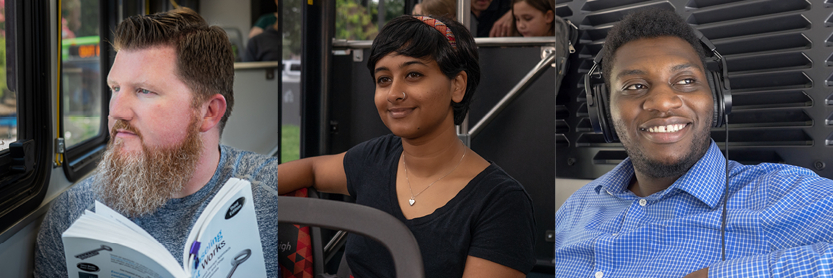
Together, GoCary, GoDurham, GoRaleigh and GoTriangle have produced the “Your Better Way to Go Campaign” to tell real stories of real riders sharing the good news about how transit can be, among other things, your stress-free, reliable, affordable and earth-friendly way to go.
“With Wake, Orange and Durham counties together growing by more than 80 people a day, our roads are going to get only more crowded, and transit will become the better way to go for more and more people,” says Mike Charbonneau, chief communications officer for GoTriangle. “We want those who aren’t taking a bus right now to see how easy and life-altering it can be.”
better way to go
As part of the campaign, you’ll see Phinehas, a jazz musician from Durham who has taken the bus to gigs and to lessons with his guitar students.
“Music teaches life sometimes. It teaches good life skills and keeps kids focused, and I’m happy to be a part of that,” he says. “I’ve been able to make my appointments riding the bus. If they say 3:30, my bus gets me there around 3 o’clock, and we’re all set. I walk to your house and it’s over and I walk back out and go to the bus again.”
Billy is a longtime Wake County public school teacher who took the bus to graduate school to get his master’s in school counseling.
“There really is a quality of life issue,” he says. “As you’re driving in the morning and traffic gets worse, there’s a multiplier effect on your mood and your state of mind. Seventy minutes of a relaxing commute on the bus with time to work is much better than a stressful hands-on commute.”
Shaina is a community organizer who takes the bus to get around to entertainment and meetings.
“By the end of [my last job], I almost felt like I was working the job to make enough money to pay for my car to get to my job,” she says. “It was depressing. I used a tank of gas every week. My tires were getting worn out. I had to pay $500 to get those replaced.”  
Find out more about how to find your better way to go at yourbetterwaytogo.org.

Sept. 10, 2019: 460,000! That's how many transit trips Youth GoPass holders took in program’s first year

Research Triangle Park, NC (Sept. 10, 2019) – In the first year of the Youth GoPass program, the Triangle’s teenagers used their free passes to board public buses to get to school, work or play across Orange, Durham and Wake counties more than 460,000 times.
Altogether, more than 6,600 teens ages 13 to 18 signed up for Youth GoPasses between July 2018 and June 30, 2019. For a list of where you can get a Youth GoPass and for more information about how the program works, please see youthgopass.com. The pass is good for free rides on all GoCary, GoDurham , GoRaleigh and GoTriangle routes. Transit in Orange County is free for everyone.
Now that the traditional school year has started up again, the transit agencies are hoping even more teenagers learn how easy it is to get a pass at Wake, Durham and Orange public libraries, Raleigh Parks and Recreation community centers and transit agency ticket counters and how valuable that free ticket to ride can be.
“We couldn’t be more pleased about our young neighbors using their new Youth GoPasses nearly a half a million times to take advantage of the access a growing transit network provides,” says Shelley Blake Curran, interim CEO and president of GoTriangle. “Transportation should never be a barrier to education or other opportunities for anyone, and our continued community investment in transit and programs like the Youth GoPass help connect more people to a lifetime of possibilities.”
Christopher Reynolds, 17, is one of more than 400 Broughton High School students with a Youth GoPass, and he uses his every day to take GoRaleigh Route 8 between his home and school. His family had been spending about $50 a month for him to use public transportation before the free Youth GoPass program started last year.
“My grandma read about the pass, and she printed out the articles about it,” Christopher says. “My mom picked me up from school one day and we went to the library, and we got it. All I needed was a student ID, which I had on me. It’s easy.”

Aug. 14, 2019: For those 65 or older, it’s now free to explore, travel, ride all over the Triangle

Research Triangle Park, NC (Aug. 14, 2019) – Added to the myriad practical reasons that Andrew Leager likes taking the bus to meet friends or run errands around the Triangle are four precious ones: Tripp, Henry, Weston and Ames.
It’s the thought of his four grandchildren inheriting a planet we’ve polluted with our car-centric ways that primarily propels Leager, a 71-year-old Raleigh native, onto public transportation.
Now GoTriangle is reducing the cost of Leager’s reducing his carbon footprint.
On Aug. 4, all customers 65 and older became eligible to ride all GoTriangle routes free simply by showing a photo ID with birthdate. The change means that members of that age group now can ride free on all transit agencies in the Triangle, although each agency has its own rules for boarding. 
“Continued access to all of the wonderful things in our community is critical to our older neighbors who maybe want to stop driving or limit their driving on our crowded roads,” says Shelley Blake, GoTriangle’s interim CEO and president. “GoTriangle is happy to be making it even easier for those 65 and up to get to health care appointments or restaurants or other places they want to see or visit.”
Leager, an avid bicyclist, lives in a walkable part of downtown Raleigh and drives his truck only about half the time he travels. He has used public transit to get to North Hills to meet a friend for lunch, to Cary to enjoy a beer at a local pub and to Durham to keep a date with a woman he met online.
“My love of transit is multifaceted,” says Leager, who has been an architect, an actor, a bar owner and a barrel-maker. “The bottom line is that I’m really concerned about my grandchildren’s future world. If all of us drove our vehicles 50 percent less, just think of the saving of fossil fuels. I want to do my part to live in a world where we don’t drive our cars as much.”

July 30, 2019: A trip through transit leads Wake teachers to real-world lesson plans

If 10 teachers leave Durham at 11:45 a.m. and travel on a GoTriangle Route 100 bus to see the transit stops at Raleigh-Durham International Airport before riding at 65 mph on I-40 to downtown Raleigh, how long does it take them to come up with 23 new lesson plans involving transit?
OK, so the Wake County public school teachers who spent a day with GoTriangle staff members as part of WakeEd Partnership’s SummerSTEM program may never use the experience to write word problems for math tests, but they left excited about creating other real-life lessons in comparative and data analysis, politics, government, economics, mapping, conservation, budgets and more.
“We always think huge on global problems and their impact,” said Emily Hardee, STEM coordinator at Brentwood Elementary School in Raleigh. “But for many of our students, it’s all about what’s right outside their houses a lot of the time.”
Hardee was the coach for the contingent of teachers visiting GoTriangle last week as part of the SummerSTEM collaboration among WakeEd Partnership, the Wake County Public School System and STEM businesses and organizations. About 100 WCPSS educators visit businesses each summer to get hands-on experiences in STEM fields so that they can take real-world lessons back to the classroom.
At GoTriangle, the day’s goal was two-fold: to immerse the teachers in all things transit to spark some creative lesson planning and to impart enough practical knowledge that they could help their school families navigate the transit network. Extra credit: getting a feel for what it’s like to be dependent on transit as some of their students and families are.

May 20. 2019: Canes mural ready for community close-ups! Now, meet the painter who got his art start on the bus

Raleigh artist Sean Kernick is quick to draw the conclusion that he might not have had an art career at all if it weren’t for the time he spent filling up sketchbooks on his daily trips on public transportation to and from school in Philadelphia.
From sixth through 12th grades, Kernick spent a total of 90 minutes each day riding, chatting, laughing and sketching along the streets of Philly, where he also picked up some spray-painting skills providing some admittedly, um, unsanctioned art with his teenaged friends.
“Time on public transportation, it’s like when you get lost in thought driving but without the responsibility of driving,” he says. “Imagine the kind of ideas you can think through and work out in your head by just taking the time to have somebody else take you from place to place. That’s where 80 percent of my sketchbook got filled up at was on the bus.”
Canes Country is the most recent beneficiary of Kernick’s self-taught talents, which were put to use this month turning the wall of a building that GoTriangle owns into a tribute to the Carolina Hurricanes’ post-season run to the Eastern Conference Finals.
“We’re honored to work with the Raleigh Murals Project and truly appreciate GoTriangle’s support in our efforts to expand the Carolina Hurricanes’ footprint in the region,” says Dan LaTorraca, director of digital marketing for the Carolina Hurricanes. “The organization is proud to showcase the creativity of local artists and leave our mark on the city that has shown us tremendous support.”
Find the mural at the corner of Harrington and Lane streets in downtown Raleigh, celebrate the Canes and snap some pictures. A gallery of downloadable photos is available here.
“We could not be more excited about this joint partnership with the Hurricanes and the Raleigh Murals Project,” says Mike Charbonneau, GoTriangle’s chief communications officer. “Now that the mural is finished, we hope the community will come by the property to enjoy it, take selfies, celebrate, whatever makes them feel like they’re a part of the energy that this Canes team and its post-season success have poured into our community.”
The Raleigh Murals Project connected Kernick, the Canes and GoTriangle, with the team providing the money for the artist and GoTriangle donating the building as the canvas.
“Not until this moment, I hadn’t remembered so deeply my love with the bus, and having the connection between the buses and this wall here, it really adds another layer to make this project super special,” Kernick says. “I still know what bus number I took. I took the 27 bus to and from school, and the connection that it created with me and other people in my community still stands to this day.”

May 17. 2019: He got on board! New home, new route, peace of mind

Research Triangle Park, NC (May 17, 2019) –  A free pass was just the nudge Andy Bechtel needed to try transit from his new home in downtown Durham to his job as an associate professor of journalism at the University of North Carolina at Chapel Hill.
When he lived in Raleigh, Bechtel had made a habit of riding GoTriangle’s Chapel Hill to Raleigh express bus for well more than a decade, but since his move to Durham last summer, he hadn’t much explored his transit options.
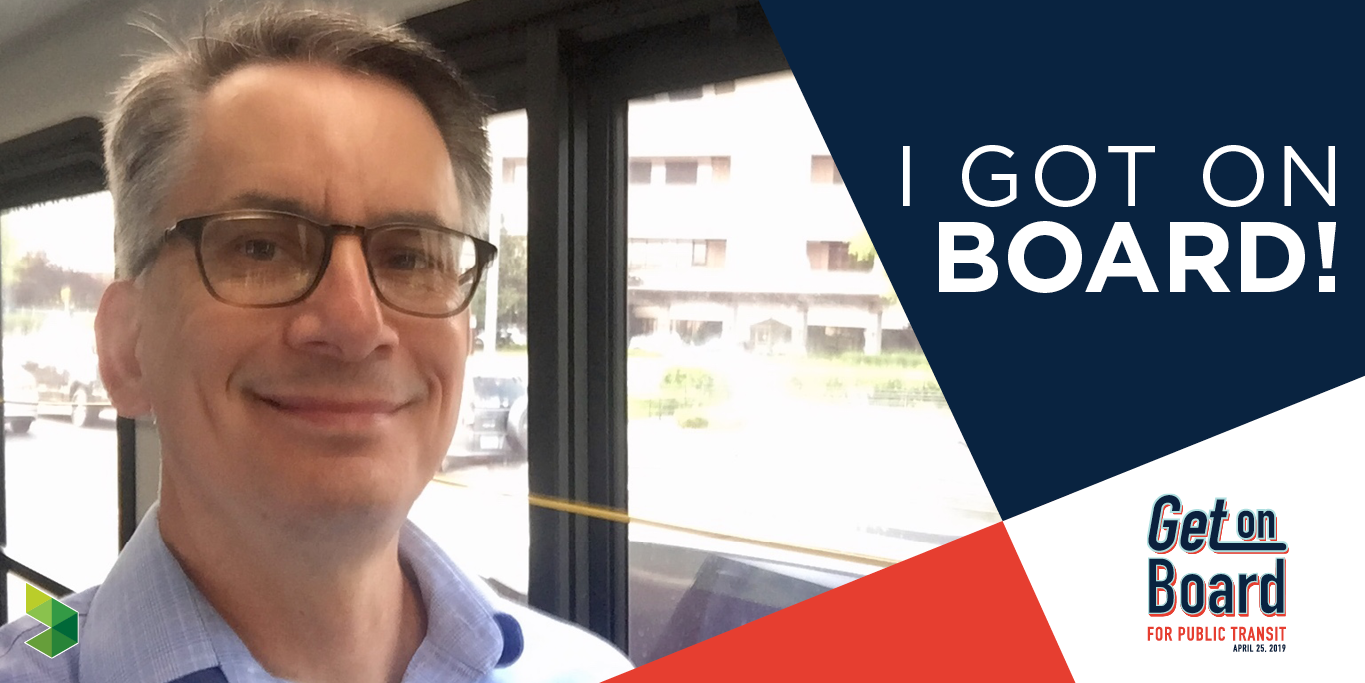
When GoTriangle offered a free ride in honor of national Get on Board Day last month, he decided it was time to look at bus schedules and routes from his new home. A stop for GoTriangle Route 400 between Durham and Chapel Hill is a 10-minute walk from his apartment, he found.
“That campaign was a nice reminder, making me think, ‘Sure, let me give this a try from my new location,’” Bechtel says. “It was easy to find where the bus was. It was easy to ride it. It was on time. It’s not an express route, so it does stop along the way, but it only added 5 to 10 minutes to my drive time, and that’s something I’m willing to do to save myself the aggravation of driving on 15-501 at 5 p.m.”
Bechtel says the Get on Board timing couldn’t have been better because he also had noticed that the price of gas was creeping up again.
“It’s not only the stress relief of being on the bus, I’m saving money on gasoline and wear and tear on my car, too,” he says.

May 16, 2019: Raleigh artist finds biking to work brings sense of belonging, real insight into city

On Friday, before artist Annie Blazejack straps on her bike helmet and pedals from her home in the Five Points area of Raleigh to her studio 4 miles away, she’ll check the weather so she can choose the appropriate clothes on national Bike to Work Day.
She’ll plan her route along the city’s backstreets, a route she’s still perfecting since moving from Miami, Florida, to Raleigh in September. Finding a path that avoids busy roads or sidewalks all together has eluded her.
And, chances are, once on her way, she’ll stop a few times to enjoy a remarkable sight or to get a coffee, which she’ll put in the water bottle holder on her bike.
This is Blazejack’s every workday routine, unless the weather is particularly bad. In that case, she’ll take an Uber, guilt-free, because of the money she and her husband have saved by owning only one car.
“He uses it for his commute because he found a job in Durham,” Blazejack says. “He has an awful commute via car, and I have a lovely commute I really like, and it’s a bike ride.”
Not having a car payment and all of the other attendant costs of owning a vehicle for 10 years meant the couple could afford to buy their first home in Raleigh.
“There’s the personal health benefit to riding your bike, no question,” Blazejack says. “Everyone kind of knows that. There’s the environmental benefit of not being responsible for all of those emissions, not being responsible for the material for making one more car. And then I think it also can be a big financial benefit, depending on how you set yourself up.”

May 8, 2019: She got on board! First transit trip turns Cary commuter into forever fan

Seeing a GoTriangle tweet offering a free bus pass to honor national Get on Board Day last month, Diane Dulaney realized she was out of excuses not to try transit.
When Dulaney’s two boys were younger, carpool duties kept her chained to her car, but with one son in college and one in high school now, she was ready to break free.
The free pass was the key.
“It took one time,” says Dulaney, a Cary resident who works as a project manager for the state Department of Public Instruction in downtown Raleigh. “I rode the bus on Tuesday, and on Wednesday I marched myself down to the state parking office and got my GoPass. I liked it so much I convinced my husband to ride the bus with me on Thursday.”
Dulaney, who has used public transit in larger cities such as New York and Boston, says she had some slight trepidation about her first bus trip in Wake County.
“The bus drivers are great,” she says. “They were very patient with me. The first day I bumbled through it. I couldn’t figure out how to swipe my card. I pulled my cord too early. The bus driver said, ‘Do you really want to get off here?’ He was super nice.”
Dulaney’s husband works on the NC State University campus, so he also has access to an employer-sponsored GoPass, which allows people to ride free on any transit agency in the Triangle. Dulaney says having both of them tuned in to transit will help the family this summer when her college son is home and needs a car.
“I’m not buying him a car for the summer so I was going to have to carpool with my husband,” she says. “Taking the bus is going to be much better than carpooling because we just have such different schedules.
From her home in east Cary, Dulaney is able to walk about 5 minutes to a bus stop that serves GoTriangle Route 301, which travels Western Boulevard and drops her off right at her office door on Wilmington Street in Raleigh. Her morning bus commute takes roughly the same amount of time as driving, although the evening bus commute can be a bit longer.
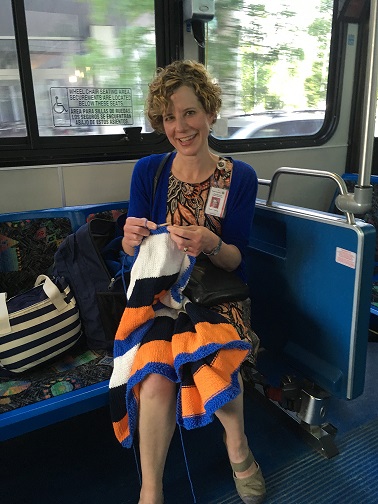
“But I really love the time I get back,” Dulaney says. “I can read on the bus. I can knit. I love to knit. I’m making this ridiculously large afghan for my son. The last one took me a year. I’m thinking if I take the bus more, I can finish this one in six months.”
Dulaney’s ultimate goal, now that one week of GoTriangle service has made her a transit lover and advocate, is to get rid of a car completely.
“If a family truly saves $10,000 a year by going down to one car, that’s a great trip you can take every year,” she says. “A great trip! And if you don’t drive, you’re so much more likely to ride a bike or walk. I don’t like to sit in a car. I’d rather be moving. And I really do feel guilty from an environmental standpoint driving my car alone to work every day.”
Dulaney is anticipating that as the Triangle keeps growing by 80 people a day, transit is going to be more than a money saver for her. It will also be a moneymaker.
“Selfishly, the fact that my house is so close to the bus line will make my house even more valuable,” says Dulaney, who lives in what she describes as an old part of Cary that made it an affordable place to buy a home 14 years ago. “Probably in 10 years, people will really start looking for that. So I want the transit system to be stronger and better, and the way for that to happen is for people to start riding the bus.”
That’s the paradox of transit planning that can be hard to understand. The more accessible transit is, the more people will ride it, so if you wait for more people to ride it before you make it more accessible, nobody wins.
“Transit is a vicious cycle or a virtuous cycle,” Dulaney says. “The more people ride the bus, the more routes we have and the better it is, and the fewer who ride, the fewer routes we have. I want it to be a virtuous cycle.”

Durham, Orange and Wake counties all have half-cent sales taxes devoted to transit improvements, so the network becomes more accessible and vast every year. Find more information here.