Monday, March 26, 2018

May 25, 2017: With an assist from local transit agencies, Valor Games offer veteran athletes competition, camaraderie and confidence

Orginally appeared at gotriangle.org

Research Triangle Park, NC (May 25, 2017) – Reverberating around the Dean Smith Center at the University of Chapel Hill are the exhortations that accompany any volleyball game: “Over, over, over!” “Coming to you! Coming to you!” “It’s out! It’s out!”
Cheers go up and backs are slapped before faces reset with determination as the next server, ball spinning in his hand, eyes his intended target on the other side of the net.
Even with a prosthetic leg stashed under the scorer’s table, it becomes easy to overlook that all of the volleyball players here at the Valor Games Southeast are seated on the floor.
Providing that sense of normalcy for wounded service members and veterans is only one goal of the three-day Paralympic sports competition, which brought 125 athletes to the Triangle during this week sandwiched between Armed Forces Day and Memorial Day. Bridge II Sports, the Durham nonprofit that has coordinated the games the past five years, hopes the competition also gives those facing life with a disability more confidence as they use sports to learn to overcome challenges.
For William Ruffin (pictured below), currently stationed with the Army’s Warrior Transition Battalion at Fort Bragg, the games offered a sense of camaraderie among all military branches that he found comforting.
ruffinCropped.jpg
“I just love everyone coming here together as one,” says Ruffin, a Maryland native who spent six years in the Marines before joining the Army 19 years ago. “Meeting new friends, sharing your experience with everyone, hearing about their injuries. I just love being here.”
This was the first Valor Games for Ruffin, who completed two tours of Afghanistan and two in Iraq as an infantryman and later a combat security expert. He suffered severe back and knee injuries during one of his deployments when an IED exploded and crumpled the tank he was riding in.

May 10, 2017: For Bike to School Day, it’s off to Northwoods Elementary School we go.

Originally appeared at gotriangle.org

Sitting on his red “Cars” bike, Nadir Dkhir is eager to get going on his ride to Northwoods Elementary School in Cary, mashing on the bike’s button that makes speeding car noises four or five times. The first-grader is proud that this is his second time participating in the national Bike to School Day.
“I did it in kindergarten, too,” he says as more than 40 parents and schoolchildren prepare to bike a greenway from Godbold Park to the school about a mile away. “It’s fun for me because of how all the people come out and do it together.”
May is national Bike Month, and Bike to School Day is one of the many events focused on helping people understand the benefits of biking. For GoTriangle, biking is an important part of its GoTogether campaign that focuses on all the ways people can get to work or school other than alone in a vehicle. GoTriangle offers information and resources, including biking tips and maps and guides to help potential riders plan safe routes, at http://gotriangle.org/bike.
“In the same way GoTriangle helps employers identify commuting plans and matches people with ride-share options, helping people learn about the benefits of cycling and pointing them toward resources to help them safely bike to school or work is part of our overall mission,” says Shelly Parker, manager of sustainable transportation at GoTriangle. “Cycling is completely removed from the traffic congestion equation and doesn’t impact the air quality negatively. It has a positive net benefit compared with making that trip in a vehicle. The more people who bike, the better.”
National Bike to School Day began in 2012 as an offshoot to Walk to School Day, which launched in 1997 as a way to highlight the importance of improved streets, healthier habits and less traffic. Northwoods has participated in Bike to School Day every year.

May 8, 2017: Friends, freedom and a sense of community: Driving a GoTriangle bus is as much about kindness as commuting

Originally appeared at gotriangle.org.
After guiding his nearly 20-ton GoTriangle bus to a flawless stop, driver Harold Swann is ready, greeting the 16 riders climbing up from the Patterson Place park-and-ride stop in Durham with a smile, a slew of “good mornings!” and a measure of mercy.
One young woman, heavy backpack in hand, has forgotten her bus pass.
“Just swipe it twice tomorrow,” Swann says kindly, then he waits until everyone is seated before heading about 7:15 a.m. toward the fourth stop of Route 400, which mostly connects workers to their jobs and students to their schools between Durham Station and UNC Hospitals in Chapel Hill.
These are Swann’s people. He loves taking care of them.
“They make my day,” says Swann, a former IBM financial analyst who has been driving for GoTriangle since 1999. “I love saying, ‘Good morning. How you doing? Are you having a good day?’ You never know how that impacts someone.”
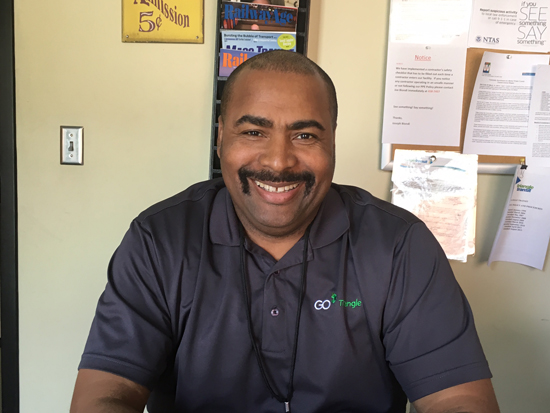
Those enjoyable interactions paired with freedom from a desk job and a dedication to good customer service and safety bring a sense of satisfaction to Swann (pictured above) and other drivers.
“If you’re a person who likes meeting people, you’ll do that here,” says Joe Smith (pictured below), who also has been driving for GoTriangle since 1999 and who, 13 years ago, married one of his passengers. “If you’re a person who feels like you’re in a rut sitting in one place all day, this is the type of job you’ll love. I never thought I’d be driving a bus this long. It wasn’t my interest, but I love it.”
GoTriangle is looking for other people like Swann, Smith and Wes Eason, another GoTriangle driver who runs the evening bus routes that start about 3 p.m.

May 4. 2017: Komen race a chance for GoTriangle and its drivers to honor those in the breast-cancer fight

Orginally appeared at https://gotriangle.org/.

Four close friends diagnosed with breast cancer within three years. A beloved sister-in-law. A cousin with an infectious laugh.
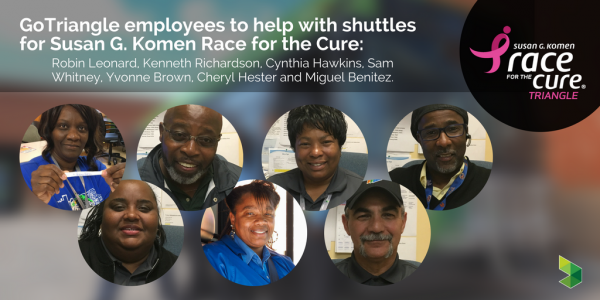
These are some of the people GoTriangle employees will be honoring Saturday when they help with the Susan G. Komen Triangle Race for the Cure in Research Triangle Park. It’s the eighth year that GoTriangle has provided buses and staff to support the event, which has $1 million in pledges this year.
“My four friends have all already been through the process of having breasts removed and having reconstruction,” says Yvonne Brown, a GoTriangle bus operator for four years. “They’re just so young. We need a cure for it.”
Brown is one of five GoTriangle drivers who will be shuttling the 8,000 race participants from park-and-ride lots to the race at the Frontier in RTP. Robin Leonard, transit manager, and Sam Whitney, dispatcher, will be providing support.
“My cousin Mel died of breast cancer,” Whitney says. “She was only 42 years old when she passed away. I’m helping because we need to find a cure, and the only way to find a cure is if we all participate.”
At GoTriangle, so many people want to help with the race each year that Leonard has to hold a drawing, this year plucking the five names of bus operators from a heart-shaped bowl. Driving in addition to Brown will be Cheryl Hester, Cynthia Hawkins, Miguel Benitez and Kenneth Richardson.
“I didn’t know so many people had breast cancer,” says Richardson, who drove the shuttle last year and whose sister-in-law is a survivor. “I can’t wait to start Saturday. I get a rush when I see a lot of people and they’re doing something for a worthy cause. I love it. I love it.”
Hawkins had put in her name before but had never been selected. Saturday will be the third time Benitez has driven for the race and the fifth or sixth time for Hester, who loves the significance but also the theatrics of the event.
“I feel so honored,” Hester says. “They thank me for taking them, and I enjoy looking at them with all the different attire, to see some with their little pink outfits on. This lady had on a skirt with ruffles all around, a too-little tutu. They have long colored socks on. It’s cute. And the little kids, they’re just adorable.”
GoTriangle bus operator Shadonna Preddie has been participating in a Komen walk every year since her cousin Pam Wilson of Knightdale was diagnosed with breast cancer in 2009. She’s planning to walk rather than drive Saturday as well.
“She and I are more like sisters,” Preddie says. “The survivors are so excited and appreciative of the love and support. It’s a humbling experience to see all of the people who have fought and are fighting and are still active and happy.”
Preddie, with GoTriangle since November, said she is touched that her company is donating buses and drivers to the cause.
“You don’t get that in many entities,” she says. “It’s something very overwhelming to see companies investing and getting out and doing something instead of just sending money. Actions speak louder than words a lot of times.”
When Brown found out her name had been drawn, she immediately called her four girlfriends. She said she was thrilled to be able to offer her driving skills and time in their honor.

“One day it could be me,” Brown says. “It could be my daughter. It could be my granddaughter. I just want a cure.”

Feb. 9. 2018: Connecting to Opportunity speakers offer ways to make light-rail project extraordinary - for all

Originally appeared at gotriangle.org.
Research Triangle Park, NC (Feb. 9, 2018) – Once light-rail cars are zipping along the 17.7-mile corridor between Durham and Chapel Hill in 2028, a 45-minute transit ride could get residents who live near Crest Street in Durham to 11,000 more jobs than they can reach in that amount of time today and those near East Lakewood at Memphis Street to 15,000 more.
Duke Hospital North could have access to 90 percent more potential employees and the light rail’s Gateway Station area to 400 percent more.
And that’s based on today’s numbers of jobs and homes.
From 2018 to 2057, the project potentially could add $3.2 billion in property value and $1.4 billion in tax revenue as well, GoTriangle projections show.
As impressive as those numbers are, what will make the project extraordinary is finding ways to increase the number of people who get to share in the prosperity by using community goals to guide the growth around the line’s nearly 20 stations, Triangle leaders say.
That was the focus this week of the Connecting to Opportunity summit sponsored by GoTriangle, Triangle J Council of Governments and Gateway Planning. The event at the Durham Performing Arts Center brought together national experts, local elected officials, business owners, developers, transit planners and community members to explore how to ensure there is room for everyone along the light-rail line.
“This is a huge opportunity to not waste,” said Meea Kang, a developer who has been spearheading affordable housing projects in California for more than 20 years. “The region can’t afford not to build the housing or the infrastructure and then to make sure it’s sustainable and resilient. I love to disrupt. The light rail is a disruption, and that’s when innovation happens.”
Among the innovative housing ideas presented at the summit were allowing Accessory Dwelling Units (granny flats and mother-in-law suites), encouraging homeowners to build garage apartments and to divide their too-large homes and creating more affordable and sustainable micro-housing.
Given the 67 people a day that Wake County is adding and the 20 people a day in Orange and Durham counties, the Triangle can’t keep building housing the way it has been over the past decades even if it wanted to.
“You’d have to add the entire acreage of Durham, all 73,000 acres, to house the people coming in,” said Peter French, CEO of Rising Barn, a builder of sustainable small homes in San Antonio, Texas. “You’re probably not going to find that.”